Population-based estimated Glomerular Filtration Rate distributions and associated health outcomes provide opportunities for early identification of and primary prevention of chronic kidney disease

Introduction
There are currently no established strategies for early identification and primary prevention of chronic kidney disease (CKD). Automatic reporting of estimated glomerular filtration rate (eGFR) allows opportunistic CKD screening. Here, we hypothesized that comparison with population-based eGFR distributions may further help identify individuals at elevated risk.
Methods
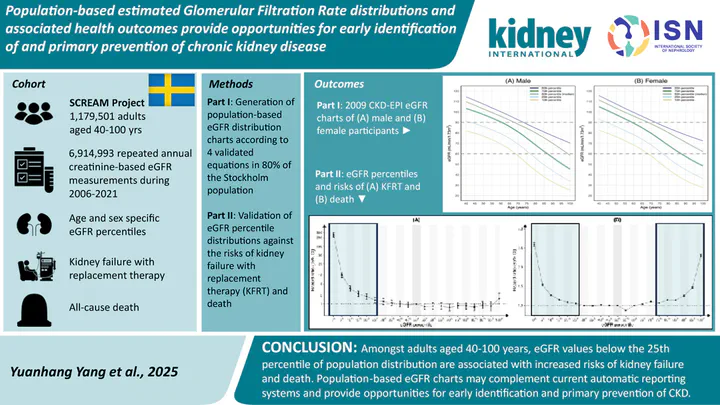
A population-based observational cohort study including adults aged 40 to 100 years with routine serum/plasma creatinine tests (Stockholm CREAtinine Measurements project) between 2006 and 2021 was conducted. The cohort captured 1,179,501 unique individuals (80% of the population in the region) with 6,914,993 repeated annual eGFR measurements. After computing eGFR distributions by age and sex, cause-specific Cox regressions evaluated the associations between eGFR percentiles and risks of kidney failure with replacement therapy (KFRT) and death.
Results
Median eGFR (2009 CKD-EPI) was lower at higher age, from 104–106 ml/min per 1.73 m2 (men–women) at age 40 to 45–50 ml/min per 1.73 m2 at age 100. Exclusion of individuals with selected comorbid conditions or adjustment for the non-tested population had minimal impact on eGFR distributions. Compared to the central percentiles (47.5–52.5th), eGFR percentiles below the 25th were significantly associated with increased risk of KFRT, and both low and high eGFR percentiles were associated with increased mortality. Associations were consistent across age groups. Among 421,547 individuals with eGFR 60 ml/min per 1.73 m2 or more who were below the 25th percentile, only 24% underwent albuminuria/proteinuria testing in the adjacent year and could have benefited from additional diagnostic work-up.
Conclusions
Our study shows that eGFR values below the 25th percentile of the population distribution are associated with increased risks of kidney failure and death. Population-based eGFR charts may complement current automatic reporting systems and provide opportunities for early identification and primary prevention of CKD.