Similar Predictive Performance and Clinical Utility of the Kidney Failure Risk Equation Using EKFC or CKD-EPI Estimated Glomerular Filtration Rate

Background
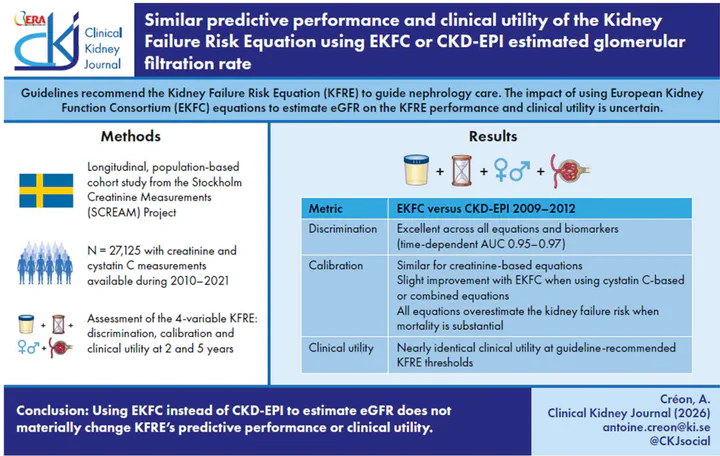
International guidelines recommend the Kidney Failure Risk Equation (KFRE), which includes estimated glomerular filtration rate (eGFR), to guide nephrology referral and preparation for kidney replacement therapy in chronic kidney disease (CKD). The European Kidney Function Consortium (EKFC) eGFR equations are increasingly recognized as alternatives to CKD-EPI, but their impact on KFRE predictive performance and clinical utility is unknown.
Methods
We identified adults with same-day creatinine and cystatin C measurements and an albuminuria assessment in Stockholm between 2011 and 2021. We evaluated 2- and 5-year 4-variable KFRE performance using CKD-EPI or EKFC eGFR equations based on creatinine (eGFRcr), cystatin C (eGFRcys), or both filtration markers (eGFRcr-cys). Discrimination was assessed using time dependent area under the curve (AUC), calibration with calibration plots, and overall accuracy with predicted risk distributions and Brier scores. Clinical utility was evaluated using decision curve analysis (DCA) at guideline recommended thresholds. All analyses accounted for the competing risk of death.
Results
Among 27,125 participants (median age 75 years; 45% women), KFRE discrimination was consistently excellent across all equations, filtration markers, and prediction horizons (AUC 0.95–0.97). For eGFRcr, EKFC and CKD-EPI showed similar calibration at the 2- and 5-year horizons. However, calibration was better for EKFC-based predictions than CKD-EPI when using eGFRcys or eGFRcr-cys. DCA demonstrated nearly identical clinical utility for CKD EPI and EKFC at guideline recommended thresholds.
Conclusions and Relevance
In this North-European health system study, estimating eGFR with EKFC or CKD-EPI equations does not materially alter the predictive performance or clinical utility of the KFRE.